

Last Updated: September 2026
If you’re looking for an offbeat place near Kasol, the Rasol Village Trek from Kasol takes you away from the busy cafés and tourist atmosphere and into one of the quieter corners of Parvati Valley.
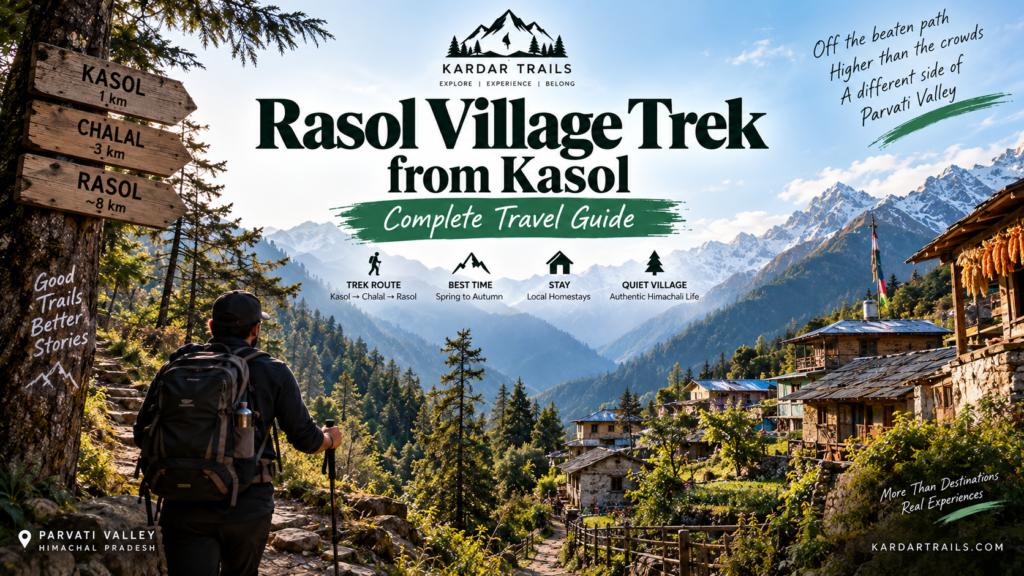
Rasol is a small traditional Himalayan village located high above Kasol and Chalal. There is no direct road to the village. The popular route follows Kasol → Chalal → Rasol, with a steep forest climb after Chalal.
The trek isn’t technically difficult in the way a mountaineering expedition is, but the sustained uphill climb can be physically demanding.
And that’s part of the attraction.
You have to walk for Rasol.
The effort keeps the village quieter, preserves its character and makes the arrival feel much more rewarding.
In this guide, we’ll cover everything you need to know about Rasol Village, including the route from Kasol, trek difficulty, approximate time, best season, accommodation, food, connectivity, safety, what to carry and how to experience the village responsibly.
Rasol Village Trek: Quick Facts
| Detail | Information |
|---|---|
| Location | Parvati Valley, Kullu, Himachal Pradesh |
| Starting point | Kasol |
| Popular route | Kasol → Chalal → Rasol |
| Access | Trekking trail |
| Difficulty | Moderate to challenging |
| Main challenge | Steep uphill climb after Chalal |
| Recommended experience | Day trek or 1-night village stay |
| Accommodation | Basic homestays |
| Food | Simple local/homestay meals |
| Connectivity | Limited and unreliable |
| ATM | No ATM in Rasol |
| Best periods | Spring, early summer & autumn |
| Monsoon | Wet and potentially slippery |
| Winter | Cold; snow possible depending on conditions |
Important: Distance, trekking time, weather and trail conditions can vary. Treat these figures as planning estimates rather than guarantees and check current local conditions before starting your trek.
Where Is Rasol Village?
Rasol is a small Himalayan village in the Parvati Valley of Kullu district, Himachal Pradesh.
It is located above Kasol and Chalal, surrounded by forests, mountain slopes and views across the wider valley.
Unlike Kasol, Rasol does not have direct road access.
You reach Rasol on foot.
This relative isolation is one of the reasons Rasol has a very different atmosphere from the busy tourist centre of Kasol.
Travel sources describe Rasol as a small settlement with traditional homes and limited tourist infrastructure. Published sources differ on the exact elevation, so it is more useful for travellers to think of Rasol as a high mountain village at roughly 3,000 metres rather than relying on one precise number.
Why Visit Rasol Village?
Rasol doesn’t have a long list of conventional tourist attractions.
That’s precisely why many travellers love it.
The experience is about:
- Trekking through Himalayan forests
- Traditional village architecture
- Mountain views
- Peace and quiet
- Local culture
- Slow travel
- Basic homestay experiences
- Escaping the busy tourist circuit
If Kasol gives you the social and backpacker side of Parvati Valley, Rasol gives you an opportunity to experience its quieter mountain side.
Kasol to Rasol Trek Route
The most popular route is:
Kasol → Chalal → Rasol
Step 1: Kasol → Chalal
The journey begins in Kasol.
You walk towards Chalal, crossing the Parvati River and entering a forested landscape.
This section is comparatively easier.
Step 2: Chalal → Rasol
After Chalal, the trail becomes much steeper.
The route climbs through pine and deodar forest towards Rasol.
This is the section that requires most of your physical effort.
Step 3: Reach Rasol
After the long uphill climb, the forest gradually gives way to the village surroundings.
You finally reach Rasol.
And the atmosphere changes immediately.
The noise of Kasol feels very far away.
How Long Does the Rasol Trek Take?
Trekking times vary according to your starting point, pace, fitness, weather, backpack weight and trail conditions.
A practical planning estimate is:
Kasol → Chalal
Approximately 30–60 minutes, depending on your starting point and pace.
Chalal → Rasol
Approximately 3–5 hours uphill for many travellers.
Rasol → Kasol
The descent is generally faster, but it can still take several hours depending on your pace and conditions.
Some travel sources give approximately 5–8 km one way, while other published figures differ because different starting points and route measurements are used.
Don’t plan your trek around an exact kilometre figure. Plan around daylight and your physical ability.
How Difficult Is the Rasol Village Trek?
The Rasol Trek is moderate to challenging for most recreational travellers.
The biggest challenge isn’t technical climbing.
It’s the continuous uphill ascent.
You should be prepared for:
- Steep sections
- Uneven ground
- Tree roots
- Rocks
- Forest trails
- Mud during wet weather
- A long descent after reaching the village
Can beginners do the Rasol Trek?
Yes, reasonably fit beginners can attempt it, but it should not be treated as an easy walk.
If you don’t regularly hike or walk uphill, take plenty of breaks and consider travelling with an experienced local guide.
The Most Beautiful Part of the Rasol Trek
For many travellers, reaching Rasol isn’t the only highlight.
The forest trail itself is an important part of the experience.
The route takes you away from the developed areas around Kasol and into quieter mountain terrain.
Depending on the season, you may see:
- Pine forests
- Deodar trees
- Wildflowers
- Rhododendrons
- Mountain orchards
- Forest clearings
- Wide Himalayan views
The landscape changes as you gain elevation.
And because you’re moving slowly on foot, you notice details that you would completely miss from a vehicle.
What Is Rasol Village Like?
Rasol is a small traditional settlement rather than a commercial tourist town.
You won’t find large hotels, busy markets or rows of modern tourist businesses.
Instead, you’ll see:
- Traditional mountain homes
- Narrow village paths
- Agricultural areas
- Forests
- Small homestays
- Local residents going about everyday life
This is important to remember.
Rasol is someone’s home.
When you visit, you’re entering a living community.
Don’t treat the village like an attraction designed exclusively for tourists.
Ask before photographing people.
Don’t enter private houses.
Follow local instructions.
And respect religious and cultural spaces.
Things to Do in Rasol Village
You don’t need a long sightseeing checklist.
The best things to do in Rasol are simple.
1. Walk Through the Village
Explore the village slowly and observe its traditional architecture and surroundings.
Don’t rush through it.
2. Enjoy the Himalayan Views
Find a quiet spot and look across the mountains.
Rasol is particularly rewarding for travellers who enjoy landscapes and photography.
3. Experience Local Village Life
Depending on the season, you may see agricultural work, traditional crafts and other aspects of everyday mountain life.
Observe respectfully rather than turning local activities into a spectacle.
4. Stay Overnight
An overnight stay can completely change your experience.
Instead of trekking up, taking a few photographs and immediately descending, you get to experience the village after the day visitors leave.
5. Disconnect
Rasol is a good place to put your phone away.
Limited connectivity and simple infrastructure naturally encourage you to slow down.
Sometimes the best activity in the Himalayas is doing nothing.
Should You Visit Rasol as a Day Trip or Stay Overnight?
Both are possible, but we recommend an overnight stay if you have enough time.
Day Trip
Morning: Kasol → Chalal → Rasol
Afternoon: Explore Rasol
Later: Begin descent towards Kasol
A day trip requires an early start and good fitness.
Overnight Trip
Day 1: Kasol → Chalal → Rasol
Evening: Explore the village and stay overnight
Day 2: Enjoy the morning → descend towards Kasol
The overnight option gives you more time to actually experience Rasol instead of treating it as a destination to tick off.
Accommodation in Rasol
Accommodation is basic.
Expect simple homestay-style rooms rather than hotels.
Facilities may include:
- Basic beds
- Simple rooms
- Local meals
- Limited electricity
- Limited connectivity
Accommodation availability and prices can change depending on season and demand.
Confirm your stay before beginning the trek whenever possible.
If you want a wider choice of hotels, cafés and facilities, stay in Kasol and visit Rasol as a trek.
Food in Rasol
Food choices are much more limited than in Kasol.
You may find simple homemade meals through local homestays.
Typical food can include:
- Dal
- Rice
- Roti
- Vegetables
- Chai
- Simple local meals
Carry some snacks from Kasol.
Don’t assume you’ll find a full range of restaurants once you reach Rasol.
Is There an ATM in Rasol?
No, there is no ATM in Rasol.
Carry enough cash before starting your trek.
It’s a simple precaution, but one that becomes very important when visiting a remote mountain village.
Is There Mobile Network in Rasol?
Mobile connectivity can be limited and unreliable.
Don’t plan your trip assuming that you will have continuous mobile data.
Before leaving Kasol:
- Download maps
- Share your travel plan
- Charge your phone
- Carry a power bank
- Save important phone numbers
- Tell someone where you’re going
Think of Rasol as a place where you may genuinely be offline.
Best Time to Visit Rasol Village
There is no single perfect month for everyone.
The best time depends on whether you prioritise trekking conditions, greenery, clear mountain views or winter scenery.
April to June: Best for Trekking
Spring and early summer can offer pleasant conditions for hiking.
The forests become greener and the valley becomes increasingly active with travellers.
For a first Rasol trek, this is one of the periods worth considering, subject to current weather.
July to September: Monsoon
Monsoon transforms Parvati Valley into a lush green landscape.
But rain can make the Rasol trail:
- Muddy
- Slippery
- Wet
- More difficult
- Less predictable
Heavy rainfall can also affect roads and access in the wider valley.
If you’re travelling during monsoon, check current local conditions before starting.
October to November: Clearer Mountain Views
Autumn can be an excellent time to explore Rasol.
After the monsoon, visibility can improve and the surrounding mountains can look particularly dramatic.
The temperature also starts dropping, especially at night.
December to March: Winter
Winter brings colder temperatures and the possibility of snow.
Snow can make Rasol beautiful, but it can also make the trail significantly more difficult.
Winter trekking should only be attempted with suitable preparation and current local information.
What to Carry for the Rasol Trek
Pack light.
Essential items:
- Proper trekking shoes
- Water
- Energy snacks
- Rain jacket
- Warm layer
- Sunscreen
- Sunglasses
- Personal medication
- Power bank
- Torch/headlamp
- Basic first-aid kit
- Identification
- Cash
If staying overnight:
Add:
- Extra warm clothing
- Extra socks
- Thermal layer during winter
- Basic toiletries
Don’t carry:
A large suitcase.
You’ll have to carry it uphill.
Rasol Trek Safety Tips
Start Early
This is one of our most important recommendations.
Starting early gives you plenty of daylight.
Check the Weather
Don’t rely only on an old blog or social media post.
Mountain conditions change quickly.
Avoid Heavy Rain
Wet trails can become slippery and significantly more difficult.
Carry Enough Water
Don’t assume every stream or water source is safe to drink from.
Keep Your Phone Charged
Connectivity may be limited, but your phone can still be important for maps, photographs and emergencies.
Don’t Trek After Dark
Avoid starting the climb late in the afternoon.
The forest trail is not somewhere you want to navigate after sunset.
Know Your Limits
If you are struggling badly, slow down.
There’s nothing wrong with turning back.
The mountain will still be there another day.
Rasol Trek for Solo Travellers
Rasol can be a rewarding destination for solo travellers.
The combination of trekking, quiet surroundings and village life makes it particularly attractive to independent travellers.
But solo trekking requires additional preparation.
If you don’t know the route, consider travelling with an experienced trekker or local guide.
Always tell someone your route and expected return time.
Is Rasol Suitable for Families?
Rasol is not suitable for every family.
The steep climb and limited infrastructure can be challenging for:
- Very young children
- Elderly travellers
- People with limited mobility
- People uncomfortable with steep trails
Fit families with older children may consider it, but the decision should depend on the family’s actual fitness and current trail conditions.
Rasol vs Kasol
These are completely different experiences.
| Kasol | Rasol |
|---|---|
| Road accessible | Trek access |
| Busy traveller atmosphere | Quiet village |
| Cafés and restaurants | Limited food |
| Many accommodation options | Basic homestays |
| Better connectivity | Limited connectivity |
| Parvati River setting | Mountain village |
| Easy sightseeing | Steep trek |
| Backpacker culture | Traditional village experience |
Our recommendation?
Do both if you have enough time.
Enjoy Kasol’s energy.
Then trek to Rasol for the silence.
Rasol vs Chalal
Chalal is closer to Kasol and easier to reach.
It offers a relatively relaxed introduction to village life and the forested surroundings.
Rasol requires considerably more physical effort.
Choose Chalal for:
- A shorter walk
- A relaxed village experience
- Easier access
- Cafés and basic tourist facilities
Choose Rasol for:
- A proper mountain trek
- Greater solitude
- Traditional village surroundings
- An overnight experience
- A more remote Himalayan atmosphere
Rasol vs Malana
Rasol and Malana are separate villages and separate experiences.
Both are associated with the broader mountain region around Parvati Valley, but they have different routes, communities and cultural identities.
Don’t assume that visiting Rasol means you’ve visited Malana.
If you’re planning to visit Malana, treat it as a separate destination and learn about its local customs and visitor restrictions beforehand.
Can You Trek from Rasol to Malana?
There are routes through the surrounding high mountain terrain and the Rasol Pass area, but these are different from the standard Kasol → Chalal → Rasol trek.
Such routes should be considered only with appropriate experience, current trail information and suitable weather.
For first-time visitors, the safest approach is to keep the route simple:
Kasol → Chalal → Rasol → Kasol.
Rasol and the Wider Parvati Valley
One reason Rasol works so well within a Parvati Valley trip is its location.
You can combine a Rasol experience with other destinations around the valley depending on your available time.
A longer trip could include:
Kasol
→ Chalal
→ Rasol
→ Manikaran
→ Tosh
→ Kalga
→ Pulga
→ Kheerganga
→ Malana
→ Grahan
→ Waichin
Not every destination needs to be visited on the same trip.
That’s the beauty of Parvati Valley.
You can come back.
Responsible Tourism in Rasol
Rasol’s greatest attraction is its traditional character.
Tourism should not destroy the very thing travellers come to experience.
When visiting:
- Carry your waste back
- Avoid unnecessary plastic
- Don’t damage forests
- Respect private property
- Ask before photographing people
- Keep noise low
- Follow local religious customs
- Don’t disturb village life
- Avoid restricted areas
- Support local businesses responsibly
Remember:
You are visiting a community, not a theme park.
Rasol Village Trek: Frequently Asked Questions
How far is Rasol from Kasol?
The commonly described trekking route is Kasol → Chalal → Rasol, with the overall one-way distance varying according to the exact starting point and route measurement. Different published sources give different figures, so plan based on trekking time and elevation gain rather than a single kilometre number.
How long does the Rasol Trek take?
The uphill journey can take several hours. A practical planning estimate is around 3–5 hours from Chalal to Rasol, with the exact time depending on fitness, pace, weather and trail conditions.
Is Rasol Trek difficult?
It is generally considered moderate to challenging because of the steep and sustained uphill climb.
Can beginners do the Rasol Trek?
Reasonably fit beginners can attempt it, but it should not be treated as an easy walk. Proper footwear, an early start and adequate preparation are important.
Is Rasol accessible by road?
No. Rasol does not have direct road access. The popular route is a trekking trail from Kasol through Chalal.
Can I stay overnight in Rasol?
Yes. Basic homestay-style accommodation is available, although facilities are limited and availability can vary.
Is there an ATM in Rasol?
No. Carry sufficient cash from Kasol.
Is there mobile network in Rasol?
Connectivity can be limited and unreliable. Download important maps and information before beginning the trek.
What is the best time to visit Rasol?
For many travellers, spring, early summer and autumn are practical periods. Monsoon can make trails slippery, while winter can bring snow and much colder conditions.
Can I visit Rasol in one day?
Yes, fit and experienced hikers may be able to complete it as a day trip, but start early and allow sufficient daylight. An overnight stay is more relaxed.
Is Rasol better than Kasol?
Neither is “better.”
Kasol offers cafés, accommodation, social life and easy access.
Rasol offers trekking, quiet surroundings and traditional village life.
They are different experiences.
Our Local Recommendation: How to Experience Rasol
At Kardar Trails, we don’t recommend visiting Rasol simply because it’s another popular Instagram location.
Go because you want to experience something different.
Start early from Kasol.
Walk through Chalal.
Take your time in the forest.
Don’t rush the climb.
Stay overnight if your schedule allows.
Talk to local people respectfully.
Wake up early.
Watch the mountains.
And then walk back down.
Rasol is best experienced slowly.
Why Explore Rasol with Kardar Trails?
At Kardar Trails, our focus is deliberately narrow:
Kasol & Parvati Valley.
Rather than trying to sell every destination in Himachal Pradesh, we are building our expertise around this valley.
We know that every traveller wants something different.
Some want:
- Trekking
- Backpacking
- Village stays
- Nature
- Cafés
- Local culture
- Peace and solitude
- Adventure
- Comfortable accommodation
Our job is to help you find the right combination.
Whether you want to explore Kasol, Chalal, Rasol, Grahan, Tosh, Kalga, Pulga, Kheerganga, Malana or Waichin, we can help you plan your experience around your time, budget, interests and travel style.
We don’t believe in one itinerary for everyone.
We believe in experiencing Parvati Valley the right way for you.
Plan Your Rasol Village Trek
Rasol isn’t the easiest place to reach.
There is no road.
There is no luxury infrastructure.
And the climb from Chalal can be demanding.
But that is exactly why it remains special.
You walk through the forest.
You climb above Kasol.
The valley gradually opens around you.
And eventually you reach a small Himalayan village where life moves at a completely different pace.
If you’re searching for an offbeat place near Kasol, a genuine village experience and a memorable Himalayan trek, put Rasol Village on your Parvati Valley itinerary.
Walk beyond Kasol.
Discover Rasol.
Experience Parvati Valley with Kardar Trails.