
The Story Behind Kardar: Meaning, Tradition and Its Role in Kullu
Some words carry more than a dictionary meaning. They carry the memory of a place—the institutions that shaped it, the people who served them, and the traditions that survived across generations.
“Kardar” is one such word in the Himalayan cultural landscape of Kullu.
To a visitor, it may simply sound like a surname or an unfamiliar local title. But within the traditional deity institutions of Kullu, Kardar refers to an important role connected with the organisation and management of a deity’s affairs. The position sits within a larger traditional system in which different functionaries—such as the Kardar, priest and Goor—have different responsibilities.
That makes the word interesting for another reason. Kullu is often described as Dev Bhoomi, the Land of Gods, but its deity tradition is not only about temples and worship. Local deities have historically been woven into village life, festivals, social relationships, ritual institutions and, in some contexts, questions of community order and authority.
So what exactly does Kardar mean in Kullu? What is the role of a Kardar? What is Tharah Kardu? And why would a modern Himalayan travel company choose this old word as its name?
The answers begin not with tourism, but with Kullu itself.
What Does Kardar Mean?
In the traditional deity system of Kullu, Kardar is an administrative and organisational role associated with a deity institution.
A useful way to understand the position is to think of the Kardar as a person responsible for the practical running of the institution surrounding a deity. Cultural documentation of Kullu’s traditional Deuli institution describes the Karmishth or Kardār as the person responsible for the overall management and organisation of the deuli, with other functionaries working alongside him.
This distinction matters because the Kardar is not simply another word for priest.
The traditional institution contains different offices with different responsibilities. The priest, or Pazyara, performs priestly duties, while the Goor has a different ritual role associated with communication between the deity and people. The Kardar, by contrast, is associated more closely with management, organisation and coordination.
Official listings of Kullu’s deities also show the title being used in connection with particular deity institutions, reinforcing the fact that Kardar is a defined traditional role rather than a generic word for anyone involved in worship.
The Deity Tradition of Kullu
To understand the word Kardar, it is necessary to understand the world in which the Kardar has traditionally worked.
Kullu’s deity tradition is one of the distinctive features of the region’s cultural landscape. Local deities are not simply worshipped as images inside temples. They can function as living centres of ritual and community life, with their own traditions, functionaries, festivals and relationships with people and other deities.
This is one reason visitors sometimes notice that a Kullu deity does not behave culturally like a fixed temple image familiar from elsewhere.
A deity may travel.
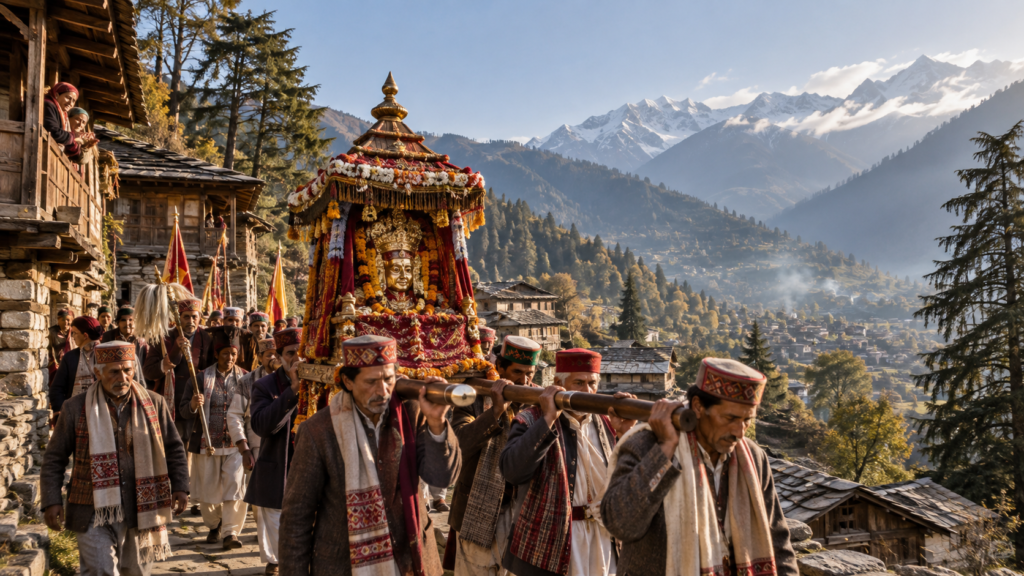
A rath or palanquin may leave its usual place and move through a village or along a traditional route. The deity may attend a fair, visit another deity, or participate in Kullu Dussehra. Such movement reflects a deeper understanding of the deity as an active participant in community life.
The result is a cultural system in which religion, landscape, community and tradition cannot always be neatly separated.
What Is Tharah Kardu?
Few expressions are more closely associated with the cultural identity of Kullu than Tharah Kardu.
But this is also an area where a little caution is useful.
Different cultural and academic sources explain the term in somewhat different ways. Some sources describe Tharah Karadu in relation to eighteen major deities and connect tharah with the number eighteen and karadu with a basket. Other cultural sources use the expression more broadly in connection with the collective deity tradition of Kullu.
Traditional references also preserve the phrase “Tharah Karadu, Tharah Narayan”, while noting that the significance of the expression has been interpreted in different ways.
For a general reader, the safest understanding is this:
Tharah Kardu belongs to the traditional cultural vocabulary of Kullu’s deity world and is associated with the collective presence of its important deities.
It should not be treated as a simple slogan detached from history. Nor should one assume that there is only one universally accepted literal interpretation of every part of the phrase.
The Story Behind the Eighteen Deities
One traditional narrative associated with Tharah Kardu tells of eighteen divine images carried in a karadu, or basket, and scattered across the Kullu landscape. Such stories should be understood as cultural traditions and narratives, rather than automatically treated as documentary history.
They matter because legends often explain how communities understand their landscape.
A mountain pass becomes connected with a deity’s movement. A village becomes associated with the arrival of a god or goddess. A sacred object acquires a history. A festival recalls an encounter between communities or divine figures.
In this way, mythology creates a map of belonging.
The Kullu landscape can therefore be read in two ways at once: geographically, as valleys, rivers, ridges and settlements; and culturally, as a network of sacred places, deity territories, pilgrimage routes and ritual relationships.
The Role of a Kardar
So where does the Kardar fit into this system?
Traditional descriptions of the Deuli institution provide a useful answer. A deity may have a number of karkun—functionaries responsible for different aspects of its affairs. Among the recognised roles are the Karmishth or Kardar, Pazyara and Goor.
The Kardar’s role is fundamentally organisational.
- Overseeing the practical management of the deity institution.
- Coordinating work connected with the deity and its traditions.
- Working with other traditional functionaries.
- Helping organise ceremonies and ritual responsibilities.
- Dealing with matters related to the deity’s affairs and community.
- Helping ensure that established practices and institutional responsibilities are carried out.
The precise arrangements can differ from one deity institution to another. Kullu’s deity tradition is not a single centrally standardised system; it is a network of related but locally specific traditions.
That is why it is better to describe the Kardar as a traditional manager or administrator within the deity institution than to force the role into a modern one-word equivalent.
And most importantly, the Kardar should not be described simply as “the priest.” The priest performs priestly duties. The Goor has a different ritual role. The Kardar has another role again—one centred on organisation, supervision and the practical functioning of the institution.
Why the Kardar Is Important to the Deity Institution
Traditional institutions work because responsibilities are distributed.
A deity system cannot function through symbolism alone. Festivals must be organised. Ritual objects must be maintained. People must coordinate. Ceremonial responsibilities must be understood. Relationships between different functionaries have to work in practice.
This is where the importance of the Kardar becomes easier to see.
The role sits at the intersection of tradition and administration.
A Kardar can be understood as someone entrusted with responsibility rather than simply granted status. That responsibility requires organisational ability, continuity and the trust of the community surrounding the deity.
Modern readers sometimes expect religious institutions to have clearly separated categories such as “religious” and “administrative.” In Kullu’s traditional deity system, those boundaries can be much more interconnected.
The Hereditary Traditions Behind the Role
Another important aspect of the Kardar tradition is heredity.
Historical and legal records from Himachal Pradesh show that Kardar offices have, in particular deity institutions, been treated as hereditary positions. At the same time, it would be misleading to suggest that every deity in Kullu follows exactly the same succession process.
The most accurate way to describe the tradition is this:
Kardar positions have traditionally been associated with particular families or lineages in many deity institutions, but the precise rules and administrative arrangements vary.
This distinction matters because Kullu’s deity tradition is not a single uniform institution replicated identically in every village. It is a network of related but locally specific traditions.
Kullu: A Living Land of Deities
The expression Dev Bhoomi Kullu makes more sense once this larger picture becomes visible.
Kullu is associated with a remarkable network of village and regional deities, many with distinctive identities, sacred geographies and ritual calendars. These traditions extend across areas including Kullu, Manali, Bhuntar, Sainj, Banjar, Anni and Nirmand.
Many deities have their own raths, mohras, festivals, associated deities and traditional functionaries. Some travel to other sacred places or fairs; others participate in Kullu Dussehra.
And then there is Kullu Dussehra.
Unlike the form of Dussehra familiar in many parts of India, Kullu’s celebration is built around the congregation of village deities. Hundreds of local gods and goddesses and their retinues may gather, with Lord Raghunath at the centre of the festival’s ritual structure.
The festival therefore creates something unusual: a regional assembly in which communities arrive with their own deities, traditions and ritual identities.
It is not merely a performance for visitors. It is a meeting point for a living cultural system.
Kardar, Community and Responsibility
The word Kardar also becomes meaningful when we look at the values traditionally associated with the role.
Trust. Responsibility. Leadership. Service. Coordination. Continuity.
These are not abstract ideas. The Kardar has historically operated within a network in which different people have defined responsibilities. The role involves working with other members of the deity institution rather than functioning independently.
That makes the Kardar a useful lens through which to understand the social character of Kullu’s deity tradition.
A village deity is not only approached during a ritual. The institution surrounding that deity can become a framework through which people participate in collective life.
The Story of Bhuvaneshwari Mata of Duraha
Among the deity traditions associated with the Nirmand area is Durah Devi, also identified with Bhuvaneshwari.
Official Kullu Dussehra records place the deity at Durah Gram Panchayat and identify the deity with the Durga tradition. They also record associated deities, an annual fair and traditional functionaries, including a Kardar and a Goor.
The wider local tradition surrounding the deity is an example of something characteristic of Kullu’s sacred geography: a deity is connected not simply with a building, but with a landscape and a network of people.
The annual festival is another expression of that relationship, bringing together local people, traditional practice, music, dance and the movement of the deity.
Our Family Connection to the Name Kardar
This is where the broader cultural history becomes personal.
The name Kardar Trails was not chosen because “Kardar” sounded like a suitable tourism brand. It comes from a family connection.
Vicky, one of the co-founders of Kardar Trails, comes from a family whose forefathers served as Kardar of Bhuvaneshwari Mata of Duraha. The family connection is rooted in Duraha in the Nirmand area of Kullu. The other co-founder is Shubham, and Kardar Trails is a partnership between Vicky and Shubham.
The decision to use the word Kardar therefore comes specifically from Vicky’s ancestral connection and from the cultural significance that the word holds for his family.
There is an important distinction here. The historical description of the Kardar role belongs to the wider cultural record. The family’s connection is a personal family history. These two things should not be confused.
What makes the story meaningful is precisely that the modern brand does not claim ownership over the tradition. Instead, it carries a word forward from an older cultural landscape.
In that sense, the name acts like a bridge.
How Kardar Became Kardar Trails
Names can shape how businesses understand themselves.
For Kardar Trails, the word points backward before it points forward.
It recalls a traditional role connected with responsibility, coordination and service within a Himalayan community. Those ideas naturally resonate with a travel company operating in the same broader cultural landscape.
But travel is fundamentally different from the traditional deity institution.
Kardar Trails is a modern travel business, not a deity institution.
The connection is cultural and personal: a family word from Kullu’s past became the name of a company looking toward the future.
From Himalayan Heritage to Modern Travel
Travel in the Himalayas is changing.
For many visitors, a destination is no longer defined only by its altitude, hotels, viewpoints or famous trekking routes. Travellers increasingly look for local stories, village experiences, cultural context and a deeper understanding of the places they visit.
That shift creates an opportunity—but also a responsibility.
To understand Kullu more deeply, you need to understand that the valley is not just a collection of scenic roads and mountain settlements.
- A village may have its deity.
- A festival may follow a traditional ritual calendar.
- A procession may have social significance.
- A sacred landscape may have a story attached to it.
- A word such as Kardar may connect an ordinary-looking name to generations of local institutional memory.
This is why cultural understanding makes travel richer.
A traveller who knows nothing about the deity tradition may see a decorated rath during a festival. A traveller who understands the culture begins to see the relationships behind it.
Why Understanding Kardar Helps You Understand Kullu
Learning the meaning of Kardar is not simply learning the definition of a word.
It introduces several larger ideas: the Kullu Devta tradition, the relationship between a deity and its community, the traditional division of responsibilities between figures such as Kardar, priest and Goor, and the idea that religious institutions can also have social and organisational dimensions.
For visitors planning to explore the region, this background can provide useful context for places they may already intend to visit.
A journey through Kasol and the Parvati Valley, for example, becomes culturally more interesting when travellers recognise that these landscapes form part of the wider cultural world of Kullu. The same principle applies when exploring villages such as Tosh, Kalga or Pulga, visiting Manikaran, undertaking the Kheerganga trek, or travelling beyond the better-known tourist routes.
The mountain road is only one layer of the journey.
The culture beneath it is another.
Travelling Through Kullu With Respect
Cultural tourism becomes meaningful when curiosity is accompanied by respect.
Visitors entering villages, temples and traditional festivals should remember that not every ritual exists for public consumption.
- Respect temples and sacred spaces. Follow local instructions, including rules about where visitors may enter.
- Ask before taking photographs. This is especially important during religious ceremonies or close ritual moments.
- Do not treat sacred traditions as entertainment alone. A procession may look visually impressive, but for the local community it can have deep religious and social importance.
- Respect village customs. Practices can differ from place to place.
- Support local communities. Responsible travel creates value for the places being visited rather than treating villages simply as backdrops for photographs.
The goal is not to make visitors feel like outsiders. It is to encourage them to become more thoughtful guests.
Kardar Trails: Exploring the Himalayas With Local Roots
Today, Kardar Trails is a Himalayan travel company built around Kullu and the Parvati Valley.
Its work includes Himalayan tours, trekking, customised journeys, motorcycle expeditions, road trips, village experiences, cultural experiences, local transportation and mountain travel.
But the relationship between the company and the word Kardar is deeper than a list of services.
The name was chosen because of Vicky’s family heritage and its connection with the cultural landscape of Kullu.
That heritage also informs a broader philosophy: travel should not only move people through a landscape; it should help them understand it.
Kardar Trails = Explore
The focus is on experiencing the Himalayas through journeys, roads, villages, trails and local stories.
Kardar Stays = Stay
Kardar Stays represents the hospitality side of the broader brand.
Together, the two create a simple idea:
Kardar Trails helps you explore. Kardar Stays gives you a place to stay.
The name connects both parts of that experience to a cultural memory rooted in Kullu.
Frequently Asked Questions About Kardar in Kullu
What does Kardar mean in Kullu?
In the traditional deity institutions of Kullu, Kardar refers to an important administrative and organisational functionary associated with a deity. The Kardar works with other traditional officials and helps oversee the practical affairs of the deity institution.
Is Kardar the same as a priest?
No. The Kardar and priest have different traditional responsibilities. The priest performs priestly duties, while the Kardar is associated more closely with management and organisation. The Goor has yet another ritual role.
What is the role of a Kardar?
Traditionally, the Kardar can be responsible for organisation, coordination, supervision and practical management of affairs connected with a local deity institution. Exact responsibilities can vary by deity and local custom.
What is Tharah Kardu?
Tharah Kardu is a traditional cultural expression associated with the collective deity tradition of Kullu. Sources differ in how they explain its precise linguistic meaning and symbolism, so it is best understood in the context of Kullu’s traditional deity culture rather than through one rigid translation.
Why is Kullu known as Dev Bhoomi?
Kullu is widely associated with Dev Bhoomi, or the Land of Gods, because of the large and culturally important network of local deities whose traditions are deeply connected with villages, festivals, sacred places and community life.
What is the Kullu deity tradition?
The Kullu deity tradition is a network of local religious institutions centred around village and regional deities. It includes temples, palanquins or raths, sacred objects, festivals, ritual functionaries and relationships between deities and communities.
Is the Kardar position hereditary?
In many historical cases, yes. Himachal Pradesh legal records document hereditary Kardar offices and succession through particular families or lineages. However, the exact succession and appointment arrangements are not identical in every deity institution.
How are local deities connected with communities in Kullu?
Local deities have historically been closely connected with village identity, festivals, ritual obligations, sacred geography and community relationships. Deity-centred assemblies can also influence wider forms of social and political authority.
Where is Bhuvaneshwari Mata of Duraha?
Official Kullu Dussehra records identify Durah Devi, also associated with Bhuvaneshwari, at Durah Gram Panchayat in the Nirmand area of Kullu district.
Why is the travel company called Kardar Trails?
The name Kardar Trails comes from Vicky’s family heritage. His forefathers served as Kardar of Bhuvaneshwari Mata of Duraha, and the word was chosen because of that personal and cultural connection.
What is the traditional culture of Kullu?
Kullu’s cultural traditions include local deity worship, fairs, village institutions, traditional music and dance, ritual processions, sacred landscapes, festivals and the wider social relationships associated with local deities. Kullu Dussehra is among the most prominent public expressions of this culture.
How can tourists respectfully experience Kullu culture?
Visitors should follow local temple rules, ask before photographing religious ceremonies, respect village customs and remember that sacred traditions are lived practices rather than tourist performances. Responsible travel begins with listening and observing.
Conclusion: Why the Word Kardar Matters
A word can carry a history.
Kardar is one of those words.
In Kullu, it belongs to an older institutional world in which local deities were—and remain—deeply connected with communities, traditions, ritual responsibilities and the cultural geography of the Himalayas.
It is a word associated with organisation and responsibility within the deity system. It exists alongside other traditional roles, including the priest and Goor. In many cases, it has also been linked to hereditary family traditions.
And for Kardar Trails, the word carries one more layer.
It connects a modern Himalayan travel company with Vicky’s family history and with a cultural landscape that existed long before modern tourism.
That is why understanding Kardar in Kullu matters.
Because when you travel through Kullu, you are not simply moving through mountains.
You are moving through a landscape shaped by stories, communities, rituals, memories and institutions.
A trail becomes more meaningful when you understand the people who have walked it before you.
A village becomes more interesting when you understand what gives it identity.
And a word becomes much more powerful when you discover the history it carries.
Kardar Trails is named after that history—and continues its own journey through the same Himalayas.
Want to know more about Kardar Trails
Sources & Further Reading
- Government of Himachal Pradesh — Official Kullu Dussehra Portal
- Government College Kullu — Devdhara
- IGNCA — Valley of Gods
- Cultural documentation on the Deuli Institution of Kulu
- Academic research on Kullu deity institutions and Kullu Dussehra
- Himachal Pradesh High Court records concerning hereditary Kardar offices