

Last Updated: September 2026
Planning a trip to Kasol or Parvati Valley and wondering when is the best time to visit?
The answer depends on what you want from your Himalayan trip.
Do you want pleasant weather and peaceful village walks? Are you planning a trek? Do you want to experience snow? Or are you simply looking for a few days away from the noise and crowds of city life?
There is no single perfect month for everyone.
Different seasons bring completely different experiences to Kasol, Manikaran, Tosh, Kalga, Pulga, Kheerganga, Malana, Waichin, Grahan and Rasol.
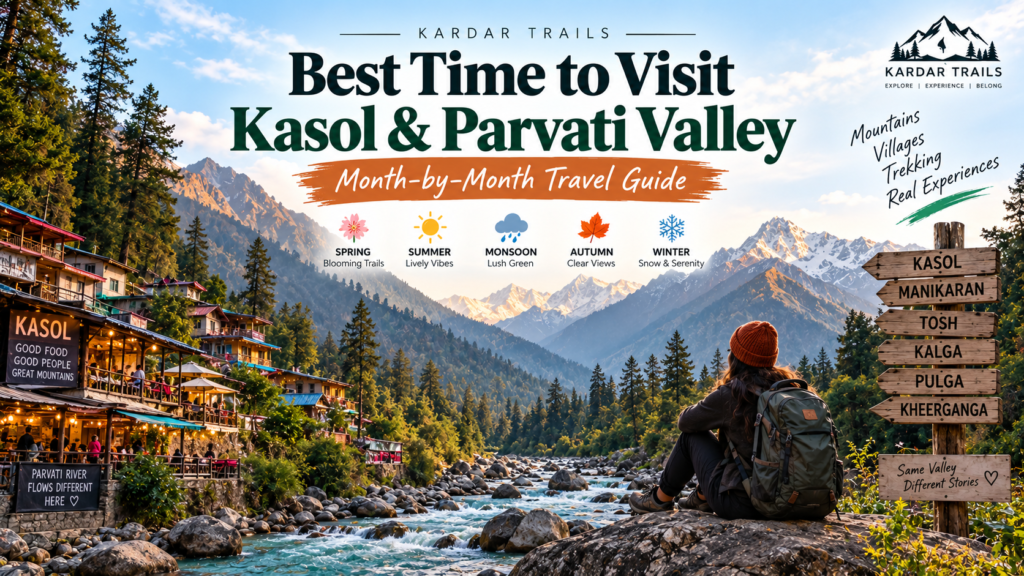
In this guide, we’ll explain the best time to visit Kasol and Parvati Valley month by month, including weather, trekking, crowds, village exploration and practical travel tips.
Quick Answer: What Is the Best Time to Visit Kasol?
For many travellers, spring, summer and autumn are the most comfortable periods to explore Kasol and Parvati Valley.
However, the best time depends on what you want to experience.
| What You Want | Best Period to Consider |
|---|---|
| First trip to Kasol | April–June / September–October |
| Pleasant weather | Spring & Autumn |
| Trekking | Spring–Autumn, depending on conditions |
| Green landscapes | Monsoon & early autumn, with caution |
| Snow | Winter, when conditions permit |
| Fewer tourists | Shoulder & quieter periods |
| Backpacker atmosphere | Summer & holiday periods |
| Village exploration | Spring–Autumn |
| Photography | Spring & Autumn |
Important: Parvati Valley is a Himalayan region. Weather, road conditions, trekking routes and local access can change quickly. Always check the latest local conditions before travelling.
Kasol vs Parvati Valley: What’s the Difference?
This is one of the most important things to understand before planning your trip.
Kasol is a destination. Parvati Valley is the larger region.
Kasol is one of the most popular bases in the valley and is famous for its cafés, traveller culture, Parvati River and easy access to surrounding destinations.
But if you have several days, don’t stop at Kasol.
From Kasol, you can travel deeper into the valley towards:
Kasol → Manikaran → Barshaini → Tosh → Kalga → Pulga
The wider region also offers experiences around:
Kheerganga → Malana → Waichin → Grahan → Rasol → Bun Buni
This is why we recommend thinking of your trip as a Parvati Valley journey, rather than simply a Kasol trip.
Parvati Valley Weather Throughout the Year
Parvati Valley changes dramatically with the seasons.
The same village can feel completely different in April compared with July or January.
Spring
The valley begins becoming greener after winter, with increasingly comfortable conditions for exploration.
Summer
Kasol becomes lively with travellers, while the surrounding villages and trekking destinations become popular.
Monsoon
The valley becomes incredibly green, but rainfall can affect roads, trails and travel plans.
Autumn
The monsoon gradually retreats and the valley can offer comfortable conditions and beautiful landscapes.
Winter
Temperatures drop significantly and higher areas may receive snow depending on conditions.
The most important thing to remember is that mountain weather is unpredictable.
A seasonal guide should never replace checking the actual conditions before travelling.
Kasol in March — The Beginning of Spring
March marks the transition from winter towards spring.
The valley gradually begins becoming greener and the days can become more comfortable for exploration.
This can be a good period for travellers who prefer a quieter experience than the main summer season.
Best for:
- Nature
- Village exploration
- Photography
- Peaceful travel
- Early-season trips
If you’re planning a trek, check current trail and weather conditions before starting.
Kasol in April — Spring Begins
April is an attractive period for exploring Kasol and the wider Parvati Valley.
The landscape begins becoming greener and temperatures can be comfortable for walking and sightseeing.
You can explore Kasol and consider travelling towards Manikaran, Tosh, Kalga and Pulga.
For trekking, conditions can vary according to altitude and current weather.
April is good for:
- Kasol sightseeing
- Village walks
- Photography
- Nature
- Trekking opportunities
- Exploring the wider valley
Kasol in May — The Valley Gets Lively
May is a popular travel month.
Travellers from across India arrive in Himachal Pradesh to escape the heat of the plains, and Kasol begins feeling noticeably more energetic.
This is a good period for people who enjoy the social and backpacking side of Kasol.
Things to do in May:
- Explore Kasol Market
- Walk beside the Parvati River
- Visit Chalal
- Visit Manikaran
- Explore Tosh
- Visit Kalga and Pulga
- Plan a trek
- Enjoy Kasol’s café culture
Because May can be busy, advance accommodation planning is recommended during popular travel periods.
Kasol in June — Summer in Parvati Valley
June is another popular month for Parvati Valley.
The weather can be comfortable compared with the heat of the plains, and travellers have plenty of opportunities to explore the valley.
June works particularly well for a multi-day Parvati Valley itinerary rather than staying only in Kasol.
You could combine:
Kasol + Manikaran + Tosh + Kalga + Pulga + Kheerganga
subject to current access and weather conditions.
Best for:
- Trekking
- Backpacking
- Village exploration
- Longer trips
- Outdoor experiences
Kasol in July — Monsoon Arrives
July brings the monsoon.
This is when the valley becomes dramatically greener, but rainfall can also make mountain travel more unpredictable.
Rain can affect:
- Roads
- Trails
- Transportation
- River conditions
- Landslide-prone areas
- Trekking access
If you’re travelling during July, keep your itinerary flexible.
Our recommendation
Don’t book a monsoon trekking trip assuming that every trail will be open.
Check the latest local conditions before starting your trek.
Kasol in August — Peak Monsoon
August is generally a wet period.
The landscape can be incredibly green, but heavy rainfall can create difficult conditions in the mountains.
This is particularly important if your trip depends on trekking or travelling deep into the valley.
August is better suited to travellers who:
- Can keep their plans flexible
- Don’t mind rain
- Want to experience a very green Himalayan landscape
- Are comfortable changing plans according to conditions
If conditions aren’t favourable, don’t force a trek simply because it was included in your original itinerary.
Kasol in September — Green Parvati Valley
September can be an interesting transition period as the monsoon gradually retreats.
The valley may still be beautifully green, while travel conditions can become more favourable depending on the year.
It’s a good month to consider if you want nature, photography and village exploration.
Best for:
- Green landscapes
- Photography
- Nature
- Village exploration
- Flexible trekking plans
Kasol in October — Autumn Arrives
October can be one of the most attractive periods for exploring Parvati Valley.
The weather can be pleasant, the landscape changes after the monsoon and the valley is excellent for outdoor exploration.
For travellers who want to combine several destinations, October can be particularly appealing.
Consider exploring:
- Kasol
- Manikaran
- Tosh
- Barshaini
- Kalga
- Pulga
- Kheerganga
Always verify current trekking and road conditions.
Kasol in November — Quiet Mountain Season
November marks the transition towards winter.
The valley becomes quieter and temperatures begin dropping.
If you don’t need a busy tourist atmosphere and simply want to slow down in the mountains, November can be an interesting choice.
Best for:
- Peaceful travel
- Photography
- Quiet stays
- Mountain scenery
- Slow travel
Pack warm clothing because temperatures can fall considerably, particularly after sunset.
Kasol in December — Winter Begins
December brings winter to Parvati Valley.
Higher areas can experience snow depending on conditions, while Kasol itself can become very cold.
The Christmas and New Year period can also make Kasol significantly busier.
If you’re visiting around the holidays, plan accommodation and transportation in advance.
Best for:
- Winter atmosphere
- Christmas and New Year
- Cold-weather travel
- Snow experiences where conditions permit
Kasol in January — Deep Winter
January is one of the coldest periods.
Higher elevations may receive snow, and some trekking routes can become difficult or inaccessible.
This isn’t necessarily the best period for someone wanting to complete multiple treks.
But for travellers who simply want a quiet winter Himalayan experience, it can be fascinating.
Best for:
- Winter landscapes
- Cold-weather travel
- Snow, where available
- Peaceful mountain experiences
Kasol in February — Quiet Parvati Valley
February continues the winter season.
Visitor numbers can be lower and the valley can feel much quieter than during peak travel periods.
However, winter conditions can affect transportation and access to higher destinations.
Always check current conditions before travelling.
Best Time for Trekking in Parvati Valley
Parvati Valley offers several trekking experiences, but there isn’t one trekking season that works equally for every route.
Popular trekking experiences around the region include:
- Kheerganga Trek
- Bun Buni Trek
- Grahan Trek
- Rasol Trek
- Sar Pass Trek
- Other local Himalayan trails
Different routes have different elevations, terrain and seasonal conditions.
Before starting any trek, check:
- Weather
- Trail conditions
- Snow
- Rainfall
- Local restrictions
- Road access
- Your fitness level
Current local information matters more than a fixed “best month” recommendation.
Best Time for Kheerganga Trek
Kheerganga is one of the most popular trekking experiences in Parvati Valley.
However, the ideal time to trek depends on current weather and trail conditions.
If you’re planning the trek, read our [Kheerganga Trek Guide] for information about the route, distance, difficulty, preparation and safety.
Kheerganga can also be incorporated into a wider Parvati Valley itinerary.
Best Time to Visit Tosh
Tosh is one of the most popular villages in the upper Parvati Valley.
Spring, summer and autumn can be attractive periods for exploring the village and surrounding mountains.
Winter offers a completely different experience and may bring snow depending on conditions.
If you’re visiting Tosh, don’t treat it simply as a photo stop.
Spend some time walking through the village, enjoying the mountain scenery and experiencing the slower pace of Himalayan life.
Best Time to Visit Kalga
Kalga is ideal for travellers looking for a quieter village experience.
Compared with the busier atmosphere of Kasol, Kalga offers a slower environment surrounded by mountains and forests.
Spring, summer and autumn can be particularly attractive for exploring the village.
Kalga is also an important starting area for trekking experiences in the upper Parvati Valley.
Best Time to Visit Pulga
Pulga is another beautiful village in the upper Parvati Valley.
One of its most recognisable attractions is the Fairy Forest, which has become popular among travellers looking for a peaceful forest experience.
Pulga is particularly suited to travellers who want to slow down, spend time in nature and experience village life.
Best Time to Visit Malana
Malana is culturally distinct from the surrounding villages and has its own traditions and social practices.
If you visit Malana, remember that you are entering a living community—not simply visiting a tourist attraction.
Respect local customs, follow current local instructions and don’t treat the village as an entertainment destination.
Weather and access conditions should also be checked before travelling.
Best Time to Visit Waichin Valley
Waichin Valley is an option for travellers who want to explore a quieter side of the region.
The valley’s mountain landscape and remote atmosphere make it attractive to nature lovers and trekkers.
As with every Himalayan destination, accessibility can change according to weather and local conditions.
Best Time to Visit Grahan Village
Grahan is an excellent option for travellers who want to experience a traditional Himalayan village away from the busier parts of Kasol.
The journey itself is part of the experience.
If you’re interested in village trekking and a quieter mountain environment, Grahan can be a valuable addition to your Parvati Valley itinerary.
Best Time to Visit Rasol Village
Rasol offers another opportunity to experience a more remote side of Parvati Valley.
It is particularly attractive to travellers interested in village walks, mountain landscapes and less conventional travel experiences.
Because mountain routes can change with weather, check current trail conditions before starting.
When Is Kasol Most Crowded?
Kasol can become particularly busy during:
- Christmas
- New Year
- Summer holidays
- Long weekends
- Major holiday periods
If you enjoy the energetic backpacker atmosphere, these periods can be fun.
But if your priority is peace and quiet, consider travelling during shoulder or quieter periods.
Is Kasol Worth Visiting in the Off-Season?
Yes.
In fact, some travellers may prefer it.
The quieter periods can offer:
- Fewer tourists
- Quieter cafés
- Peaceful walks
- More relaxed village experiences
- A slower pace
- Different accommodation options
The trade-off is that some businesses, transportation services or activities may operate differently than during peak travel periods.
The off-season is best for travellers who are flexible.
How Many Days Do You Need in Kasol?
For a short introduction, 2–3 days can be enough to experience Kasol and a few nearby attractions.
But if you want to explore Parvati Valley properly, consider 4–7 days.
With additional time, you can avoid rushing and include several destinations.
Example 5-Day Parvati Valley Trip
Day 1 — Kasol
Explore Kasol Market, cafés, Parvati River and nearby areas.
Day 2 — Manikaran + Kasol
Experience the religious and cultural side of the valley.
Day 3 — Tosh + Barshaini
Explore the upper valley.
Day 4 — Kheerganga
Take a trekking day, subject to current conditions.
Day 5 — Kalga + Pulga
Slow down and experience the quieter side of Parvati Valley.
This is only an example. Your itinerary should depend on weather, fitness, transportation and your interests.
What Should You Pack for Kasol?
Your packing list should change according to the season.
Essentials
- Comfortable walking shoes
- Warm layer
- Rain jacket
- Water bottle
- Sunscreen
- Sunglasses
- Personal medication
- Power bank
- Small backpack
- Identification
- Some cash
For Winter
- Thermal layers
- Heavy jacket
- Gloves
- Warm socks
- Appropriate winter footwear
For Monsoon
- Waterproof jacket
- Backpack rain cover
- Extra socks
- Quick-drying clothing
If you’re trekking, pack specifically for the route rather than carrying your entire travel luggage.
Kasol Travel Tips for First-Time Visitors
1. Don’t Rush
Parvati Valley is much better when you slow down.
2. Keep Your Itinerary Flexible
Mountain weather can change quickly.
3. Carry Some Cash
Don’t assume every location will have reliable digital payment or ATM access.
4. Respect Local Communities
Villages are homes, not theme parks.
5. Don’t Litter
Carry your waste back with you.
6. Check Trekking Conditions
Never assume a trail is open simply because an old travel blog says it is.
7. Don’t Underestimate the Mountains
Even a popular trek can be physically demanding.
8. Keep Emergency Contacts Available
Mountain travel requires preparation.
Responsible Tourism in Parvati Valley
Parvati Valley is more than a holiday destination.
It is home to local communities, forests, rivers, wildlife and a unique Himalayan culture.
As tourism grows, responsible travel becomes increasingly important.
When visiting:
- Carry your waste back
- Avoid unnecessary plastic
- Don’t pollute rivers and streams
- Respect local customs
- Don’t damage forests or plants
- Follow local restrictions
- Avoid excessive noise
- Support responsible local businesses
- Don’t enter restricted areas
Leave the valley as beautiful as you found it.
Our Local Recommendation: When Should You Visit?
If you’re asking us at Kardar Trails for one simple recommendation, we wouldn’t immediately give you one month.
We would first ask:
What do you want from Parvati Valley?
If you want a first-time experience with comfortable exploration, consider spring or autumn.
If you want the lively backpacker atmosphere, consider the popular summer and holiday periods.
If you want lush green landscapes and don’t mind unpredictable weather, monsoon can offer a unique experience—but flexibility is essential.
If you want winter and snow, choose the colder months, but understand that mountain access can change.
And if you’re coming specifically for trekking, choose the trek first and then check the conditions for your dates.
That’s a much safer approach than choosing a month from a generic tourism calendar.
Why Explore Parvati Valley with Kardar Trails?
At Kardar Trails, our focus is simple:
Kasol and Parvati Valley.
Rather than trying to cover every destination in Himachal Pradesh, we are building our expertise around this valley.
We understand that travellers don’t all want the same experience.
Some want trekking.
Some want cafés and backpacking culture.
Some want quiet villages.
Some want comfortable stays.
Some want to explore the famous destinations.
Others want to go beyond the usual tourist circuit.
We help travellers plan around their:
- Travel dates
- Number of days
- Group size
- Budget
- Fitness level
- Interests
- Preferred travel style
We can help with:
- Kasol trips
- Parvati Valley tours
- Kheerganga Trek experiences
- Bun Buni Trek
- Tosh trips
- Kalga and Pulga stays
- Manikaran visits
- Custom itineraries
- Local transportation
- Accommodation
- Group travel
- Multi-day Himalayan experiences
Our goal is not simply to take you from one tourist attraction to another.
It’s to help you experience Parvati Valley properly.
Plan Your Kasol & Parvati Valley Trip
There is no single perfect time to visit Kasol.
There is only the season that best matches the experience you’re looking for.
Spring brings new greenery.
Summer brings energy and travellers.
Monsoon transforms the valley into a lush landscape.
Autumn brings beautiful mountain conditions.
Winter creates a quieter and colder Parvati Valley.
So choose your season carefully, check the latest local conditions, pack appropriately and leave enough time to slow down.
Because Parvati Valley isn’t a place you should simply tick off a list.
It’s a valley you should experience.
Explore Parvati Valley with Kardar Trails.
Check our Packages